
A Virtuous Cycle of Recycled Plastic
From collection to reward: a circular process, and its first object
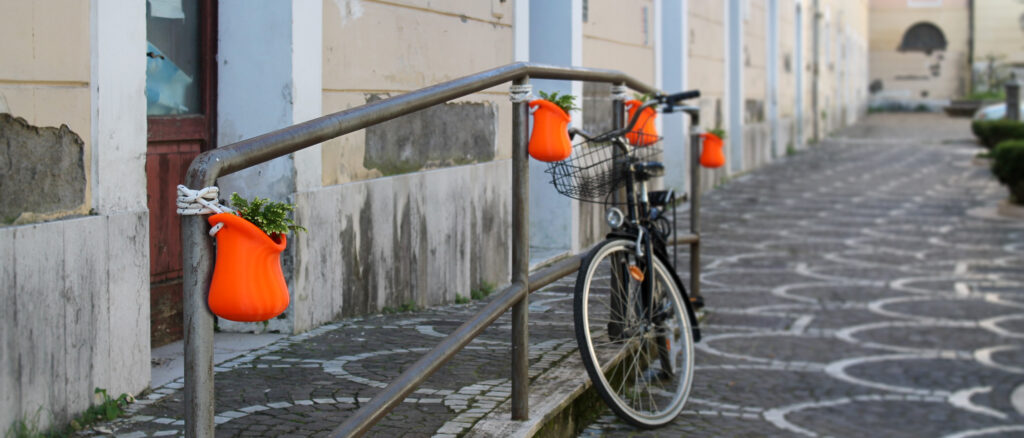
Someone drops a plastic bottle into a collection point. Weeks later, a bright orange planter hangs from a railing on their street, full of rosemary, free for anyone to pick. Between those two moments sits NODO.
We designed NODO as a virtuous cycle before we designed it as an object. It is a loop that connects collection, recycling and reward, turning discarded plastic into a shared gesture of care and handing that care back to the people who set it in motion. The recycled plastic planter most people recognise as “NODO” is what that loop produces first: proof that the cycle closes, and that it closes around something worth keeping.
It is Affinity Space’s first collaborative project, built to live in public space and to grow with every community it reaches.
The cycle
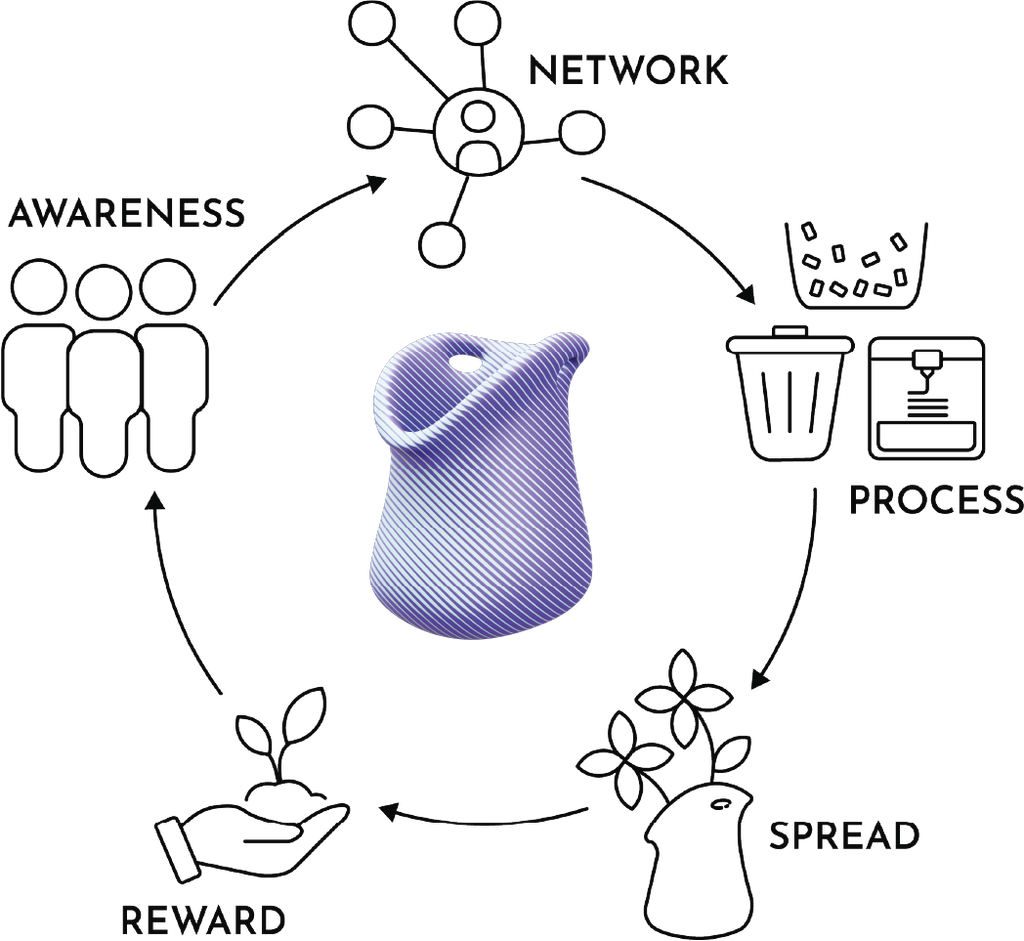
The core of NODO is a loop that moves through six moments and returns to its start. Each stage feeds the next; nothing is a dead end.
Awareness → Network → Process → Spread → Reward → (and back to Awareness)
- Awareness. Recognising plastic waste as a shared problem, and a shared resource.
- Network. The heart of the project. Involving people and institutions so that plastic collection carries a common meaning. Collection points, agreements and events turn individual gestures into a network with a common goal.
- Process. Collection, cleaning and sorting of the plastic; pellet and filament preparation; 3D printing; installation in the urban context.
- Spread. The object enters public space, changing how a corner of the city looks and feels.
- Reward. Aromatic plants, spices and local species are made freely available for people to pick, creating a tangible interaction that pulls users back into the loop.
Because the material and texture of each output change according to the plastic that was collected, every cycle carries the fingerprint of the community that fed it.
The loop is not a diagram on a wall. It is a participated production, where whoever receives the object becomes part of the network that sustains it.
The first output: the NODO planter
Every cycle needs a first object, and NODO’s is a hanging planter that repurposes thermoplastic waste into urban furniture. It clips onto existing supports like poles, railings and fences, without a footprint of its own, and it carries the plants that make the “reward” stage real.
The vessel is compact, 180 mm tall and 130 mm wide, with roughly 1.2 L of volume, and each unit reuses the equivalent of about eight 1.5 L plastic bottles. The first prototype was 3D-printed in PETG using conventional FDM (0.3 mm layer height, 242 g per print), in a deliberately loud orange chosen to stand out against the grey of the urban context. A recycled plastic rope handles the hanging.
The planter is the beginning of a catalogue, not the end of it. NODO is the first object of a workshop Affinity Space wants to found, a productive space where the same virtuous cycle can generate the next outputs.


Two paths to keep the cycle turning
The loop was designed to scale in two directions at once. A filament / DIY path lets any community 3D-print its own output on conventional printers, with files and recycled filament shared openly. A pellet / scalable path enables a mass-production chain for larger installations, using recycled material that needs no further processing after pelletising. Open where it can be, industrial where it needs to be, so the cycle can turn at the scale of a single maker or a whole city.
Design for impact
NODO was shaped from the start by the UN Global Goals, with targets under Goals 11, 12, 13 and 15, from sustainable urbanisation and reduced waste generation to protecting biodiversity. But the real ambition is quieter than a target. It is to place a strange, bright object on a railing and let a stranger decide to take care of it, and in doing so to keep the cycle alive.
Milestones
The virtuous cycle has been tested and spread through a series of public moments:
- RO Plastic Prize 2022 (Milan). NODO was selected for the exhibition, moving from concept to a physical object shown during Milano Design Week.
- Milano Design Week 2022. Around 100 NODI were placed and given away across the city, to passers-by, fellow designers and local shops, in a guerrilla dissemination campaign.
- Limited edition with Canapuglia. A limited run went on sale through Canapuglia’s own shop, extending the project beyond Milan.
- Nebula event (Naples). A capsule production raised funds for the future workshop, with NODO as its first catalogue object.
Partners & credits Design & concept: Affinity Space, Main Studio · Project lead: Fabrizio De Lucia · Production: Ginger Additive (pellet 3D printing) · Prototype & guerrilla campaign sponsor: INVIVO · Hemp rope & limited edition: Canapuglia


